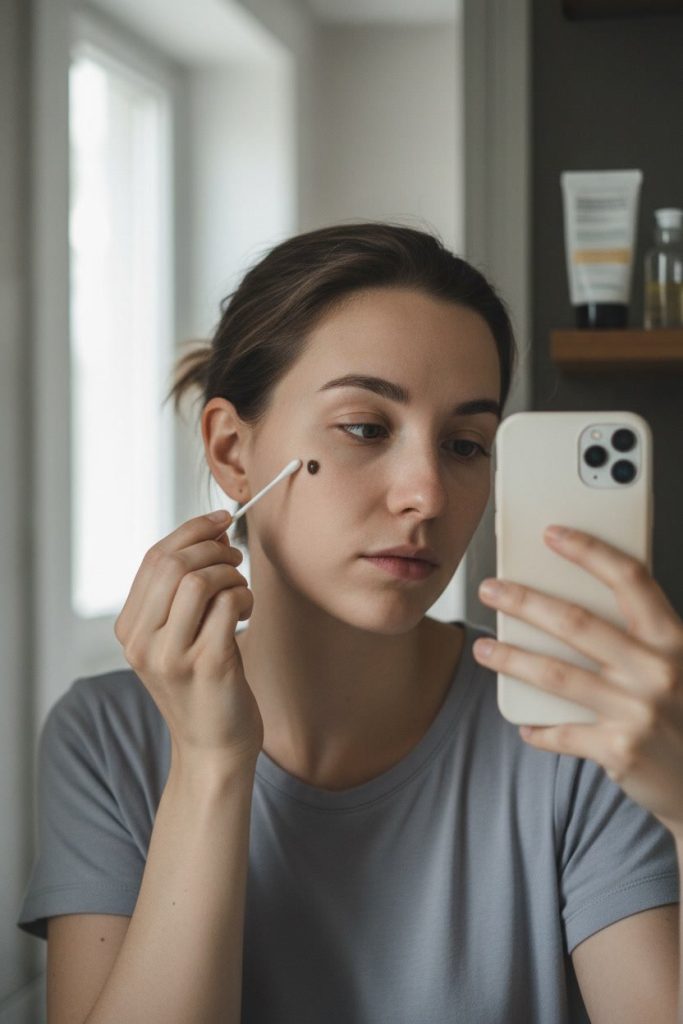
Most of us have a few moles and never give them a second thought. They sit quietly on an arm, a shoulder or the back, and after a while we stop noticing them. That is exactly why a changing spot can go unchecked for years – and why so many skin cancer stories begin with the same sentence: “I thought it was just a mole.”
Stories like this have one thing in common. The spot was there for a long time, it slowly changed, and nobody took it seriously until a doctor looked at it closely. Sometimes what comes out is a harmless cyst or a clogged gland. Sometimes it is a melanoma that has been growing under everyone’s nose. The difference between those two outcomes is often just how early someone asked a doctor.
Not every “mole” is a mole
When a doctor removes a long-ignored bump, it can turn out to be many different things:
- Epidermoid cyst – a small sac under the skin filled with keratin. It can grow, get inflamed and, when removed, the contents look surprising.
- Seborrheic keratosis – a waxy, “stuck-on” brown growth, very common after 40 and harmless.
- Dermatofibroma – a firm little bump, often on the legs, that dimples when you pinch it.
- Basal cell carcinoma – the most common skin cancer. It often looks like a shiny, pearly bump or a sore that never fully heals.
- Melanoma – the most dangerous skin cancer, which can start in an existing mole or appear as a new dark spot.
The ABCDE rule: when a mole needs a doctor
Dermatologists use a simple checklist. Look at your moles and ask:
- A – Asymmetry: if you drew a line through the middle, would the two halves look different?
- B – Border: are the edges ragged, blurred or notched instead of smooth?
- C – Color: are there several shades – brown, black, red, white or blue – in one spot?
- D – Diameter: is it larger than about 6 mm, the size of a pencil eraser?
- E – Evolving: has it changed in size, shape, color, or started to itch, crust or bleed?
“E” is the most important. A mole that is changing deserves attention, even if it ticks none of the other boxes.
The “ugly duckling” sign
Most of your moles look alike – like brothers and sisters. A spot that looks different from all the others, the “ugly duckling”, is worth showing to a doctor even if it seems small.
Why people wait too long
- The spot is on the back, scalp or behind the leg, where they can’t see it.
- It doesn’t hurt – most skin cancers are painless early on.
- It has “always been there”, so change goes unnoticed.
- They are embarrassed to “bother” a doctor about a mole.
How to check your skin at home
- Once a month, after a shower, stand in front of a full-length mirror in good light.
- Use a hand mirror for your back, scalp and the backs of your legs – or ask a partner.
- Don’t forget the soles of your feet, between your toes, and under your nails.
- Take photos of moles you want to watch, so you can compare them next month.
What happens at the doctor
A doctor will usually look at the spot with a dermatoscope, a small magnifying light. If it looks suspicious, they remove it under local anesthetic – it takes a few minutes – and send it to a lab. Caught early, melanoma is one of the most curable cancers. Caught late, it is one of the most dangerous.
The lesson
A mole you have “had forever” is not automatically safe. If something on your skin is new, growing, changing, bleeding or simply looks different from the rest, don’t wait years to find out what it is. A five-minute check can save your life.
This article is for general information and is not a substitute for medical advice. If you are worried about a spot on your skin, see a doctor or dermatologist.